
Touching down at Bandaranaike airport in Colombo, Sri Lanka, late last Saturday, for the first time in over three years, my uber driver cruised down the highway and straight into the country’s annual Vesak celebrations.
It was after midnight, and my hotel was just a few kilometers away, but we weren’t moving anywhere.
Children with their heads stuck out of car sunroofs, beaming in glitter masks, young men and women excitedly hopping between the traffic on their scooters, lines of people queuing up to sample free cardamon tea and pastry snacks, prepared by this proud local urban community – united, in finally hosting a festival that had been de-railed for the previous four years in a row.
2023 Vesak was jump starting a country that has faced some of the worst crises since peace broke out in 2009: the Easter terrorist attacks in 2019; the protracted fallout from the COVID-19 pandemic; the country’s subsequent economic downturn and fuel crisis. Sri Lanka has endured all of these things and yet, into the early hours of Sunday morning, its citizens were resolute in their celebrations, bringing the traffic to a joyful standstill.
I was simply delighted to be once more back on the island. Readers of this blog will know a little about my mini obsession with the country and in spite of the recent turmoil in Sri Lanka, I’ve kept my ties these past few years mainly through my commitment as a Board Member to Chrysalis, and to their immaculate work in support of women and youth. Time with their team last week reinvigorated me, their ongoing innovation and commitment to social change is second to none.
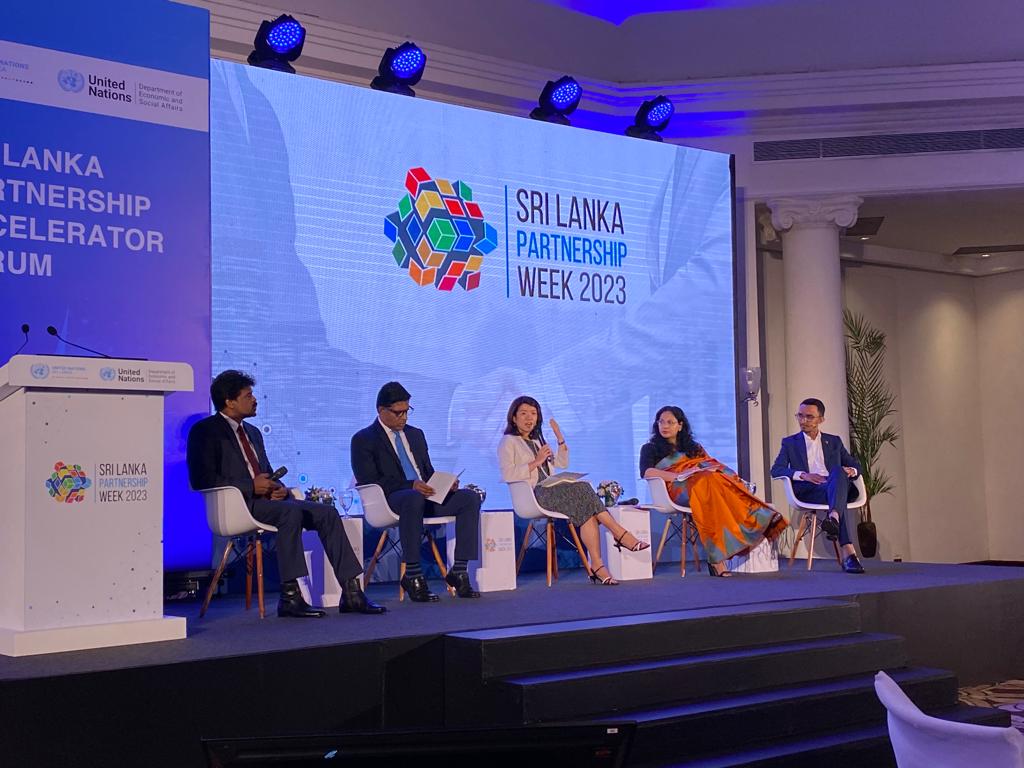
On Monday, the Chrysalis CEO, Ashika Gunasena, and I attended a high-level Forum hosted by UN Sri Lanka and UNDESA (the United Nation’s department for Environment and Social Affairs).
The event kicked off a week of training events and discussions, on the part of the UN’s various agencies in the country, about the power of partnerships.
One hundred guests attended the opening Forum and heard a rallying call to action from a range of groups, representing not just the UN but civil society, the private sector and academia.
The central tenet was simple: it is imperative to embrace multi-stakeholder partnerships as a means to address the country’s societal issues. Speaker after speaker echoed this sentiment. Each taking turns to amplify the reality that it can only be in working together, and across all sectors, that the country might overcome its current social and environmental crises.
Like Vesak, it felt like an auspicious time to be back in Sri Lanka. A turning point, perhaps, for a country grappling with how best to move its economy and its society forward.
Audience members voiced concerns about trust and transparency between sectors seeking to collaborate and, at times, the Forum struck a more somber tone. However, overall, there was a sense optimism and a shared determination that the country simply cannot risk falling further behind economically.
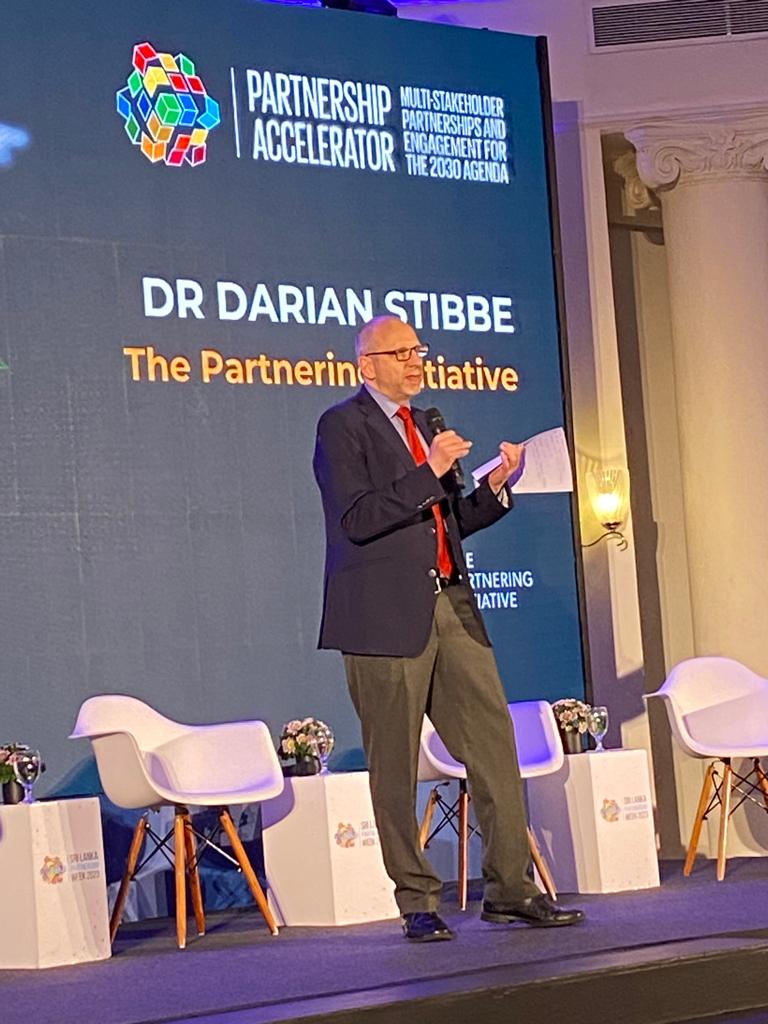
As an Associate of The Partnering Initiative, I attended the full ‘Partnerships Week’ in a training capacity, joining TPI’s Founder, Darian Stibbe, in the facilitation of a 4-day set of modules on partnering, in collaboration with UNDESA.
The course is known as the Partnership Accelerator, and is designed to offer training on partnership fundamentals, as well as share learning about more complex partnering issues and troubleshooting for when things go awry, as they can often do.
The first half of our week was spent with almost 50 participants, drawn predominantly from across UN and Government departments. This was followed by a second two days of “Training of the Trainers” where we worked with 15 colleagues assigned to take forward the partnership curriculum to their teams, and to their partners.
The concept of creating both the momentum for partnering, as well as strengthening the requisite skills for organisations using this approach, means that, over time, an exponential number of colleagues become empowered to better leverage partnerships to the best effect.

This is the second TPI Partnership Accelerator I’ve delivered, and the course is highly effective.
The content is finely tuned from TPI’s 20 years of experience in designing and managing capacity building courses like this one. We offer theory, we share frameworks. There are case studies to dissect, and TPI tools to utilise. All as you would expect.
The extra ingredient, that makes the sessions so rewarding, are the participants themselves.
Unlike some training courses, the participants do not get a lot of time sat listening to power-point slides. Instead, they are up on their feet designing role plays, performing sketches in front of their colleagues, creating real life scenarios where they can experiment with such things as ‘how to build trust’, or ‘how to overcome power imbalances’ – two typical characteristics that many multi-stakeholder partnerships face.
These group performances are fun and energetic, and this helps create solid conditions for learning.

With emails piling up in participants’ in-boxes, and some being summoned to urgent, last minute government meetings, it was a testament to our teams last week that so much of their energy to learn, and to collaborate with one another, were still at high levels by the closing sessions on Friday.
Their curiosities for how to transfer new knowledge into their work was piqued throughout the 4 days and it was a true privilege to work alongside so many committed and creative colleagues.
If these are, indeed, auspicious times for the country, then I returned home feeling more than just a flicker of excitement about how these times might yet be positively shaped, by some of those in the room with us last week.

 saigonsays